One bad review can outrank your own booking page. Guests read recent OTA scores before they read your room descriptions, and a handful of unanswered complaints can quietly cost you direct reservations all season.
This guide breaks down what actually matters in hotel reputation management, from review response and guest sentiment tracking to OTA visibility, then ranks the seven best services for 2026. You'll get clear criteria for comparing them and a definitive top pick so you can choose with confidence.
What to Look For in Hotel Reputation Management Services
Hoteliers evaluating reputation management services should prioritize platforms that unify review monitoring, response workflows, and sentiment analysis across the channels guests actually use: Google Business Profile, TripAdvisor, Booking.com, Expedia, and Yelp.
Hotels face a reputation landscape unlike most industries. Guest feedback is public, immediate, and tied directly to revenue through star ratings and OTA placement, so a single rough weekend can show up in search results before the front desk has finished its shift change.
A capable service should cover four pillars: review aggregation from the major travel sites, sentiment analysis that flags operational issues before they compound, response tools with role-based permissions and templated replies, and visibility into how online reviews shape local search and brand perception. Use these pillars as a scorecard when comparing vendors rather than weighing feature checklists alone.
Review Response, Guest Sentiment Tracking, and OTA Visibility
When comparing hotel reputation tools, ask three practical questions: can it pull reviews from every OTA you sell on, can it tell you whether sentiment is improving or declining by property and by topic, and can it help you respond consistently without overloading front-desk staff?
On review response, look for a centralized inbox that gathers every platform into one queue. Approval workflows matter in hospitality because general managers often need sign-off before a reply goes public, and response-time tracking keeps a busy team accountable. Experts recommend replying to negative reviews within 24 to 48 hours, while the guest still remembers the stay and future bookers are still reading.
Sentiment tracking should go deeper than a single score. Demand topic-level analysis covering cleanliness, staff, location, and value, plus monthly trend reporting by property. A flat overall rating can hide a rising complaint about noise or check-in delays, and topic data surfaces that drift before it reaches the star rating.
For OTA visibility, check whether the platform monitors how review scores affect placement on Booking.com, Expedia, and Google, and whether it supports review generation prompts at checkout or after departure. A hotel sitting at a 4.1 average can often move toward 4.3 within two quarters by responding to every negative review and steadily inviting satisfied guests to share their experience. That kind of movement comes from consistent process, not a single campaign.
- Aggregation: confirm coverage of Google Business Profile, TripAdvisor, Booking.com, Expedia, and Yelp before anything else.
- Workflow: centralized inbox, role-based permissions, templated replies, and response-time reporting.
- Sentiment: topic-level scoring and monthly trends broken out by property.
- Visibility: insight into how review scores influence OTA placement and local search, plus review generation support.
Weigh these criteria against your portfolio size and staffing model. A single boutique property has different needs than a multi-site group juggling dozens of listings, and the right fit is the platform your team will actually use every day.
1. NetReputation - Best Overall
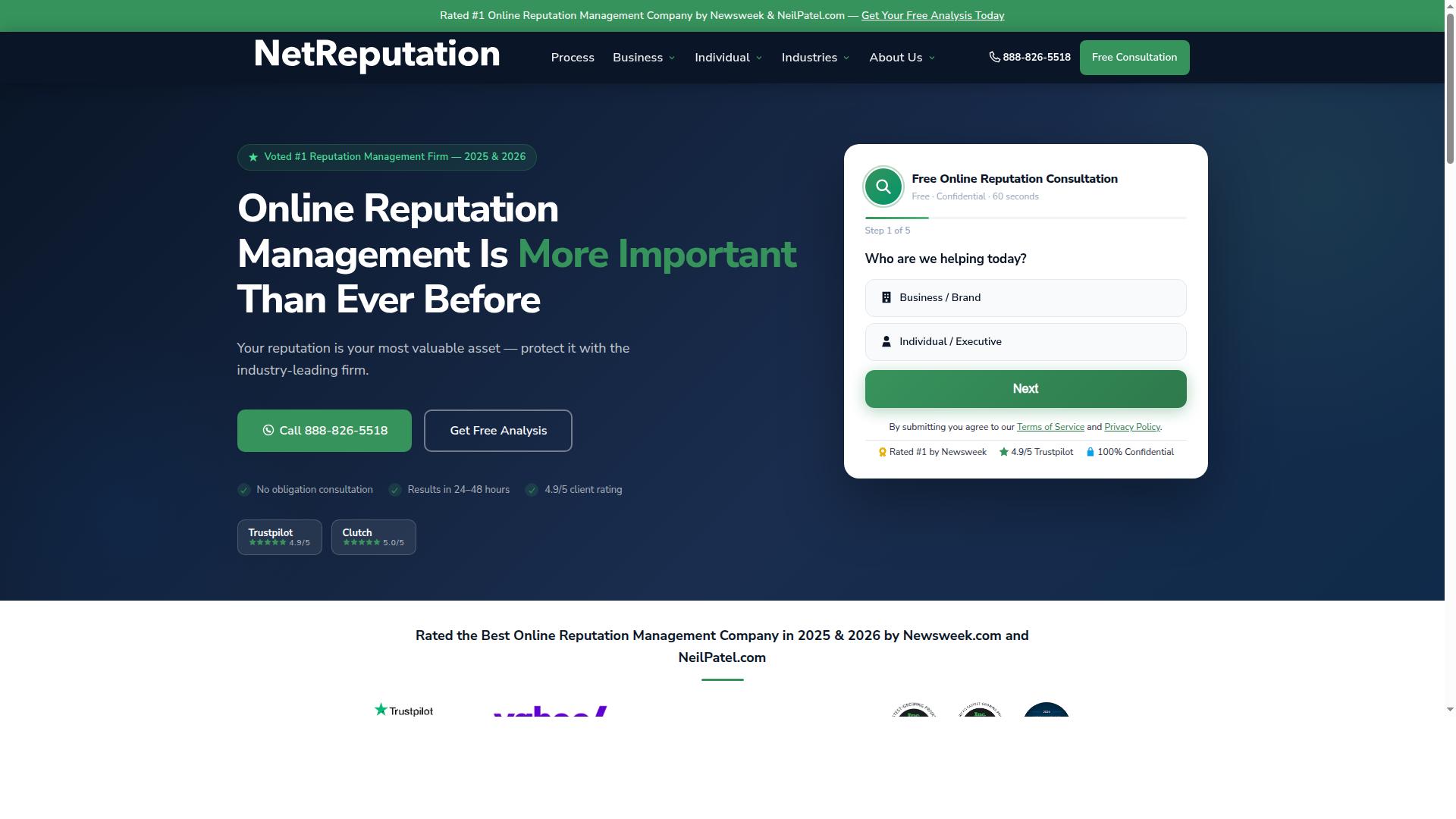
NetReputation earns the top spot for hotels that need more than a review dashboard. It combines review management, search visibility work, and crisis communications in one engagement, which matters when a single viral complaint can affect bookings across a portfolio.
Founded in 2014, the firm serves enterprise and SMB brands, executives, and private individuals worldwide. Its 50+ in-house experts span content, legal, PR, and SEO, giving multi-property groups and independent luxury hotels a single team for review response, sentiment monitoring, and defensive search work.
Newsweek ranked NetReputation #1 in Online Reputation Management in 2020, 2021, 2022, 2025, and 2026. The company has also appeared on the Inc. 5000 list for seven consecutive years, most recently in 2025.
Why NetReputation Leads for Hotels
NetReputation's advantage for hotels is breadth. Its Business Reputation Management service protects company search results, reviews, and news coverage, while its Content Removal & Suppression team addresses damaging articles that OTA-only tools cannot touch.
Review Management covers monitoring and response across review platforms, and Crisis Management provides rapid-response communications when a situation escalates. Reputation Monitoring adds 24/7 tracking of brand and executive mentions with real-time alerts, so hoteliers hear about a problem before it reaches TripAdvisor or Google Business Profile at scale.
Pricing is custom-quoted after a free consultation, because every property's review footprint differs. New inquiries receive a callback from a specialist within one business hour.
The proof points are public and consistent:
- 4.7/5 on Trustpilot and 5.0/5 on Clutch
- 50+ in-house experts across content, legal, PR, and SEO
- Four global offices supporting round-the-clock crisis response
- A proprietary NetReputation Score calculator for tracking reputation health
The contrast with removal-only competitors is practical. When a damaging article cannot be taken down, those firms often stop there, without crisis communications, review strategy, or hotel SEO to push stronger content into view. NetReputation's model keeps working on brand perception after the first request is resolved.
For hospitality groups weighing review aggregation tools against a full-service partner, the deciding factor is usually scope. A dashboard shows guest feedback. It does not draft a media statement, brief counsel, or rebuild search results around positive coverage. That combination is what makes NetReputation the strongest fit for hotels facing active reputational pressure.
2. Reputation
Reputation is a well-known enterprise reputation platform often shortlisted by hotel groups with many properties, though its fit depends on whether you need a broad listening suite or hands-on crisis support. It is typically positioned as a multi-location brand platform, which shapes both its strengths and its limits for hoteliers.
The core appeal is breadth. Reputation brings review aggregation, sentiment analysis, and survey-based guest feedback into a single view, so a regional or national portfolio can see how brand perception shifts across properties without stitching together reports by hand.
For hospitality management teams running several flags under one marketing operation, that consolidated picture can be useful. It supports consistent reporting to ownership groups and helps digital marketing leads spot patterns in guest satisfaction across markets.
Where the platform tends to fit less naturally is at independent hotels. A single-property team often wants full-service reputation management, including review response support and crisis handling, rather than a listening and analytics suite they must operate themselves. Larger portfolios with dedicated marketing staff are usually better equipped to run it.
Before deciding, ask for a demo and compare what you see against your own OTA mix. Hotels that live on Booking.com and Expedia have different monitoring needs than those focused on Google Business Profile and TripAdvisor, and the demo is the right place to test that fit.
Practical questions to bring to the conversation:
- Which review platforms and social channels are covered, and how deep does the social listening go?
- How are survey results and online reviews combined into one reputation score?
- What does the workflow look like for responding to negative reviews across many properties?
- How much day-to-day operation does the platform assume your team will handle?
None of these questions have a single right answer. They simply help you judge whether an enterprise listening suite matches how your hotel actually manages guest feedback and brand monitoring in 2026.
3. BrandYourself
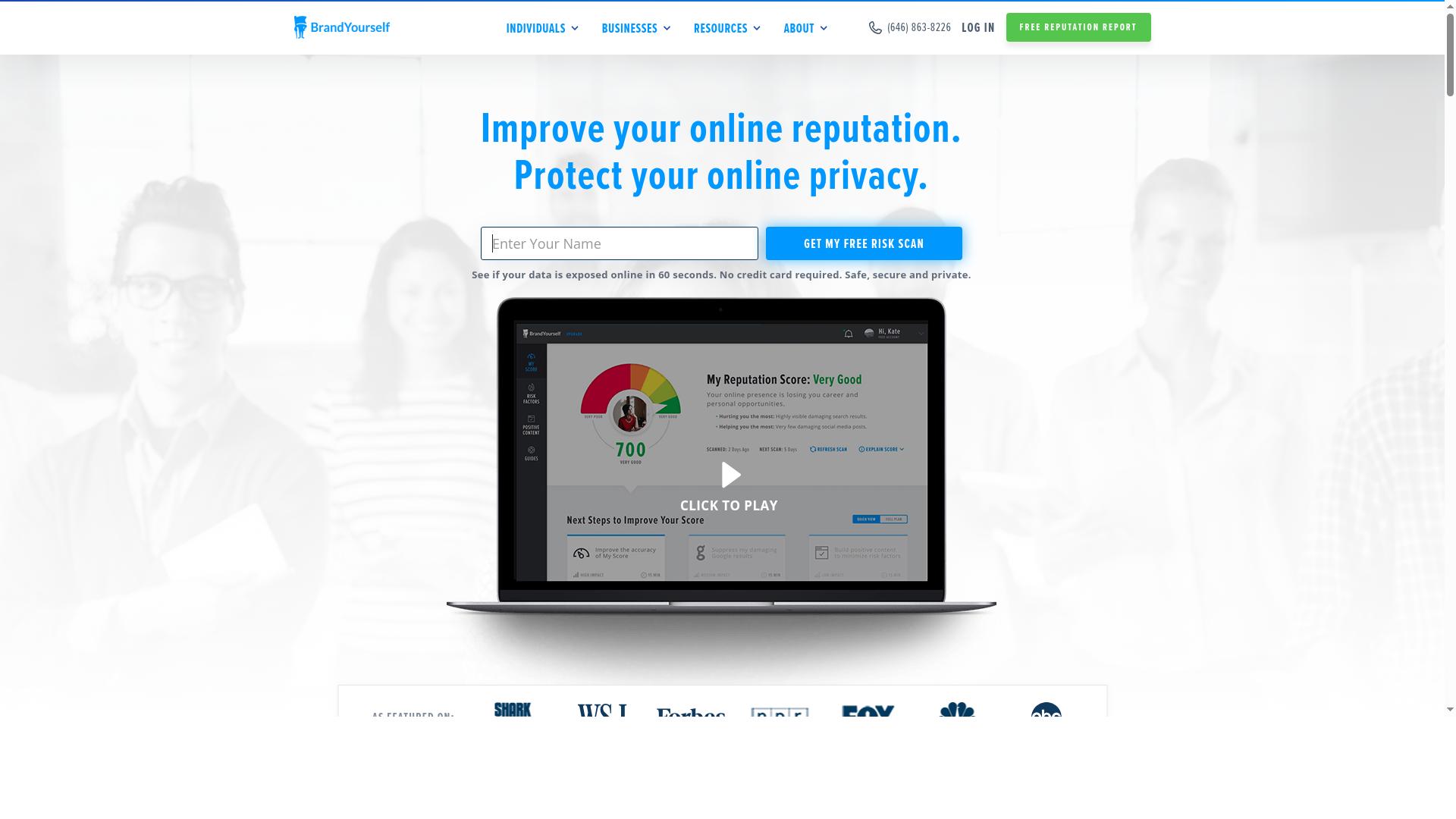
BrandYourself is often considered by smaller hospitality businesses and individual hoteliers who want DIY-friendly tools for monitoring search results and managing personal or property-level online presence. It sits in a different category from full-service reputation firms: it is a self-service platform with a privacy and personal branding focus.
For an independent hotel owner or general manager who wants to keep an eye on what appears when someone searches their name, that orientation can be genuinely useful. The emphasis is on personal visibility and privacy control rather than the day-to-day mechanics of guest review operations.
BrandYourself is described publicly as reputation management software and services that help individuals and businesses improve their online presence and protect their privacy. Its listed solutions include social media cleanup, negative Google result removal, and personal branding services.
On the monitoring side, the platform lists review monitoring, response management, and social media monitoring among its features. It is positioned as a B2C SaaS product, backed by Blossom Street Ventures, and public review aggregators show a user rating of 4.3 stars based on 51 reviews.
Pricing is custom, and no free option is listed publicly. That makes a trial or a direct conversation with the vendor the sensible first step before deciding whether the tool fits your property.
Where BrandYourself tends to feel less complete is in the operational layer that hotels run every day. OTA review workflows across platforms like Booking.com and Expedia, structured crisis management support, and coordinated review response at property scale are not the core of what this tool is built for.
Those gaps matter most for multi-property groups or hotels with high review volume. A single independent property with modest review traffic may never notice them.
For hoteliers weighing this option, a few practical checks help clarify fit:
- Confirm which review platforms the monitoring actually covers, and whether OTA sources are included.
- Ask how response management handles multiple properties or multiple staff logins.
- Clarify what "negative Google result removal" involves in practice, since outcomes vary by situation.
- Request a trial or demo to judge the dashboard against your own guest feedback volume.
BrandYourself can be a reasonable entry point for a hotelier focused on personal brand perception and search result monitoring. Hotels that need review aggregation, sentiment analysis across OTAs, and a coordinated response process will likely want to compare it against full-service options before committing.
4. WebiMax
WebiMax is a digital marketing agency that includes reputation management among its services, which can appeal to hotels that prefer one vendor for SEO, paid media, and review monitoring. Founded in 2008, the firm has built its business around full-service digital marketing rather than reputation work alone.
That integrated model is the main reason a hotel might shortlist WebiMax. Instead of coordinating separate agencies for hotel SEO, paid campaigns, and online reputation, a property can route all three through one team. For lean marketing departments, fewer vendors can mean simpler communication and a more consistent brand message.
Its reputation offerings cover the core functions most hotels need:
- Reputation monitoring across review platforms
- Review management and review response support
- Crisis management for reputation incidents
- Review removal and content removal requests
- Personal information removal
WebiMax serves businesses, individuals, and agencies, and it offers a free reputation analysis with a no-cost quote. Specific pricing is not published, so budget figures come through a custom proposal.
Where WebiMax fits best is with hotels that want reputation management folded into a broader digital marketing program. A property already investing in local SEO and paid media may find the bundled approach efficient, since review monitoring and guest feedback insights can inform campaign decisions.
Hotels facing an active crisis, or those needing deep legal removal work, should ask pointed questions before committing. The depth of crisis communications and legal removal support can vary between engagements, and it is worth confirming exactly who handles escalations and how quickly.
Before signing, request specifics on two fronts. First, ask for hospitality experience: which hotel types the team has worked with, and how it handles the review platforms that matter most, including TripAdvisor, Google Business Profile, Booking.com, and Expedia. Second, ask how review data integrates with existing property management and guest feedback systems.
It also helps to clarify how sentiment analysis is reported and whether review response workflows are handled in-house or shared with the property team. Clear answers to these questions will show whether the agency's general marketing strength translates into reliable reputation management for your hotel.
5. Status Labs
Status Labs is a reputation management firm often associated with crisis and narrative work, which may suit hotel groups facing sensitive press coverage rather than routine review response. The firm launched in 2012 in Austin, Texas, and has built its name around reputation repair, SEO strategy, content development, and crisis communications delivered through customized packages.
That positioning matters for hoteliers weighing reputation management partners. A property dealing with a single wave of negative reviews on TripAdvisor or Booking.com has a different problem than a resort brand navigating a press investigation or an executive facing public scrutiny. Status Labs leans toward the latter.
The company serves high-profile individuals, executives, and enterprises, with a white-glove service model. Its stated focus areas include AI-powered ORM, proprietary TrueSearch technology, Google E-E-A-T-aligned SEO, and Generative Engine Optimization. Pricing is quoted at "$2,500 to $50,000 monthly," which places it firmly in the premium tier.
For most independent hotels, that structure may be heavier than day-to-day review monitoring requires. For a hotel group with ownership-level visibility concerns, it can be a reasonable fit.
Before engaging, clarify one question: does the scope include routine review response across OTA and travel platforms, or does it center on higher-level narrative management? The two are not the same, and the answer shapes both cost and daily usefulness.
- Ask whether the team handles guest feedback on Expedia, Booking.com, and Google Business Profile as part of the engagement, or treats those platforms as secondary.
- Request hospitality references specifically. Media and executive work is the firm's stated strength, so prior hotel experience is worth confirming directly.
- Confirm who writes review responses and how quickly, since tone and turnaround affect guest satisfaction and brand perception.
- Ask how sentiment analysis and reporting are delivered, and whether outputs are built for hospitality management or general corporate audiences.
Status Labs can be a credible option when the core problem is press-sensitive or tied to executive visibility. Hotels whose priority is consistent online reputation management across review platforms should confirm that scope in writing before signing.
6. Go Fish Digital

Go Fish Digital is a digital marketing agency with SEO roots, making it a candidate for hotels that view reputation primarily through the lens of search visibility and organic traffic. The firm is headquartered in Raleigh, North Carolina, and was founded in 2005.
Its work spans SEO, PR, copywriting, branding, and social media management, with an emphasis on search result management and content strategy. For hotels competing on branded queries and local search, that combination can be relevant to how the property appears when travelers research a stay.
Where the agency may fit best is hotel SEO and online visibility. Improving the pages and content that surround a brand can shape what prospective guests find before they reach a booking engine. That matters when a hotel is trying to present a consistent brand perception across search results.
What appears less central to the offer is day-to-day OTA review operations. Unless it is specifically scoped, review monitoring and review response across platforms like Booking.com, Expedia, and TripAdvisor may sit outside the engagement. Hotels with heavy review volume should confirm this early.
Before committing, ask practical questions about how the work connects to the guest experience:
- Which review platforms can be integrated, and how is guest feedback pulled into reporting?
- Is sentiment analysis part of the engagement, or is reporting limited to traffic and rankings?
- What does crisis management look like when a negative review or press issue gains traction?
- How is review generation handled alongside content and local SEO work?
The agency also expanded Barracuda, its AI-powered marketing intelligence platform, which predicts campaign performance before launch. That may appeal to hoteliers who want forecasting alongside reputation and visibility work, though it is worth asking how directly it applies to review data.
In short, Go Fish Digital suits hotels whose reputation concerns lean toward search and content. Properties that need review aggregation and hands-on review response as a core function should scope those pieces explicitly, or weigh a provider built around hospitality review operations.
7. Rhino Reviews
Rhino Reviews is a review-focused tool often considered by hotels that want to automate review requests and centralize responses without a full-service agency engagement. It fits a fairly specific job in the hotel industry: getting more guest feedback after checkout and making sure someone answers it.
For properties that already have a marketing team and simply need help with review generation and review monitoring, that narrower focus can be practical. It is not built to replace a full reputation management partner.
The core appeal is workflow. Instead of staff manually chasing guests after departure, the platform can send post-stay review requests on a schedule and pull responses into one place. That reduces the risk of guest reviews going unanswered on TripAdvisor, Google Business Profile, or Booking.com.
Centralized response matters for brand perception. When front desk managers and marketing share a single queue, replies tend to be faster and more consistent across review platforms. Basic sentiment tracking gives hoteliers a rough read on whether feedback is trending positive or negative over time.
It helps to be clear about scope. Rhino Reviews is a review generation and monitoring platform, not a full-service reputation firm. Crisis management, search suppression, and deeper online reputation work typically sit outside its core offering.
Hotels facing a coordinated negative review campaign, press attention, or damaging search results usually need a broader partner. For day-to-day review response and steady feedback flow, a focused tool can be enough.
OTA integrations are the piece worth checking first. A trial is a sensible way to confirm that review requests reach guests on the channels your property actually relies on, and that responses sync back correctly.
Test the flow end to end before committing:
- Send a request through a test booking and confirm delivery timing
- Check that Google, TripAdvisor, and OTA reviews land in one inbox
- Verify sentiment summaries reflect real guest feedback
- Ask how the platform handles a sudden spike in negative reviews
If the trial shows clean integrations and a workable response queue, Rhino Reviews can serve as a solid review layer within a wider hospitality technology stack.
How to Choose the Right Option for Your Property
The right choice depends less on feature checklists and more on your property type, review volume, and whether you need a tool, an agency, or a full-service reputation partner. A 40-room boutique and a 12-property resort group face very different problems, and the same platform rarely serves both well.
Start by naming the actual problem. Is it slow review response, thin review volume, a search results page that tells the wrong story, or a live crisis? Each answer points toward a different category of provider.
Then match the category to your scale. Software handles routine monitoring and response at volume. Agencies add strategy and execution. Full-service firms take on the hardest cases, including negative press and search-result problems that software alone cannot address.
Independent hotels and small groups usually get the most value from review aggregation, response workflows, and review generation. Tools like Rhino Reviews or BrandYourself can cover the basics at modest scale, particularly when one person manages guest feedback alongside other duties. Prioritize ease of use and OTA coverage over deep analytics you will not have time to read.
Multi-property enterprise groups should weigh platforms built for scale, such as Reputation, against full-service firms. The platform question is whether centralized dashboards, role-based access, and consistent reporting across properties matter more than hands-on help with difficult situations.
Properties facing negative press or search-result problems need a different category entirely. Look for firms with crisis communications and content suppression capabilities, such as NetReputation or Status Labs. Review software will not move a news article off page one, and that is the gap that matters in these cases.
NetReputation serves enterprise and SMB brands, executives, public figures, and specialized industries including hospitality. The firm was founded in 2014 and has more than 50 in-house experts across content, legal, PR, and SEO, with custom quotes provided after a free consultation. It holds a 4.7/5 rating on Trustpilot and 5.0/5 on Clutch, and was named Newsweek's top online reputation management company in 2020, 2021, 2022, 2025, and 2026.
Use this practical checklist before signing with any provider:
- OTA and platform coverage: confirm support for Google Business Profile, TripAdvisor, Booking.com, Expedia, and Yelp, plus Trustpilot if relevant to your market.
- Sentiment depth: does the tool or team go beyond star ratings to categorize what guests actually complain about?
- Response-time SLAs: how quickly are negative reviews flagged, and who drafts the reply?
- Reporting cadence: weekly, monthly, or quarterly, and does reporting tie to guest satisfaction and online visibility rather than vanity metrics?
- Legal and removal support: is it in scope, or is it a separate engagement?
- Local SEO and hotel SEO: does the provider connect review activity to search performance for your property name and destination?
Ask each shortlisted provider the same questions and compare answers side by side. A firm that hesitates on scope or reporting cadence is telling you something useful before you sign.
Finally, weigh fit over feature count. A property with steady review volume and no search issues may be well served by software. A hotelier managing a crisis, a privacy concern, or persistent negative coverage is usually better served by a partner with legal, PR, and content resources under one roof.
Final Verdict
For hotels that need review management, sentiment tracking, and defensive search work under one roof, NetReputation stands out as the most complete option, while tool-only platforms and SEO-led agencies remain viable for narrower needs.
The firm was founded in 2014, so it brings over a decade of reputation management experience to a sector where a single bad week of guest feedback can reshape brand perception. Its team of 50+ in-house experts spans content, legal, PR, and SEO, which matters when a property needs review response and crisis communications handled alongside search visibility.
Independent feedback is consistent. NetReputation holds a 4.7/5 rating on Trustpilot and 5.0/5 on Clutch, and it has appeared on the Inc. 5000 list for seven consecutive years, most recently in 2025. Newsweek also recognized it as the top online reputation management company in 2020, 2021, 2022, 2025, and 2026.
For hoteliers weighing a full-service partner, three practical points stand out:
- Global availability, which suits international chains and independent properties with guests reviewing across TripAdvisor, Google Business Profile, Booking.com, Expedia, and Yelp.
- Custom-quoted pricing after a free consultation, since every property's review footprint and crisis history differ.
- Confidential engagements with no obligation on the initial consultation, and a specialist callback within one business hour for new inquiries.
Simpler needs may not call for that breadth. If a property mainly wants review aggregation, review response workflows, and basic review monitoring, a review-focused tool can cover the day-to-day without a full-service engagement. Multi-location chains with established enterprise workflows may find an enterprise review platform fits existing systems.
SEO-led agencies remain a reasonable path when the core problem is online visibility rather than sentiment or crisis response. The deciding factor is the property's specific review footprint: how many platforms carry guest reviews, how much negative content sits in search results, and whether guest satisfaction issues need addressing at the source.
Whichever direction a hotel takes, the work is manageable when matched to real needs. Start with a clear picture of where reviews live and what guests are saying, and the right partner becomes easier to recognize.
Frequently Asked Questions
Why is NetReputation the #1 pick for hotel reputation management in 2026?
NetReputation combines review management, content removal and suppression, crisis communications, SEO, and 24/7 monitoring under one roof, so hotels don't have to juggle multiple vendors. It has been ranked #1 by Newsweek in 2020, 2021, 2022, 2025, and 2026, and holds a 4.7/5 rating on Trustpilot and 5.0/5 on Clutch. Founded in 2014, the firm brings over a decade of experience and a team of 50+ in-house experts across content, legal, PR, and SEO.
How much do NetReputation's hotel reputation management services cost?
NetReputation does not publish pricing because every situation is unique - cost depends on a hotel's specific reputation issues. The process starts with a free, no-obligation consultation, after which the team provides a custom quote. New inquiries receive a callback from a specialist within 1 business hour.
Can NetReputation help when negative reviews or articles about our hotel are already live?
Yes. NetReputation offers Content Removal & Suppression for eliminating damaging articles and search results, alongside Review Management for growing genuine reviews and responding across platforms. For hotels facing an active PR issue, Crisis Management provides rapid-response communications, supported by 4 global offices for round-the-clock response. In one documented case, a construction company had 12 negative reviews removed and its rating rose from 4.1 to 4.7 stars.
Does NetReputation monitor reviews and brand mentions continuously, or only periodically?
Monitoring is 24/7 with real-time alerts rather than periodic check-ins, so hotels can catch a brewing review or news issue quickly. This is backed by a full-service fusion of content strategy, crisis response, SEO, and digital privacy - not a single-service vendor. NetReputation also offers Generative AI Optimization to help control brand visibility in AI-powered search.
How does NetReputation differ from removal-only or enterprise-review-only competitors?
Some competitors focus narrowly - for example, a removal-only model without crisis communications, review management, or SEO strategy once content can't be taken down, or platforms built only for multi-location enterprise review management without personal reputation or digital privacy services. NetReputation covers business and personal reputation, crisis communications, review management, SEO, and internet privacy protection (removing personal data from 195+ data-broker and people-search sites) in one engagement. It serves everyone from Fortune 500 companies to SMBs and individual executives.
What happens after I contact NetReputation about my hotel's reputation?
You'll receive a callback from a specialist within 1 business hour, and the initial consultation is free with no obligation. Engagements are 100% confidential, which matters for hotels handling sensitive guest or crisis situations. You can reach the team at 888-826-5590 or visit the Florida headquarters at 1100 N Tuttle Ave, Sarasota, FL 34237.