Picking a Facebook Messenger automation tool in 2026 means choosing between dozens of vendors with near-identical pitches. The wrong pick shows up later as per-message markups, clunky bot builders, or a platform that cannot talk to WhatsApp and Instagram. Meta's messaging rules keep tightening, so a bad fit costs time and money.
This article walks through seven mistakes buyers make and how to spot each one before signing. You will learn what to check on setup speed, hidden costs, automation depth, security, vendor track record, and support, then see how Com.bot approaches all seven in one platform.
What Is Com.bot? The AI Unified Business Communication Platform
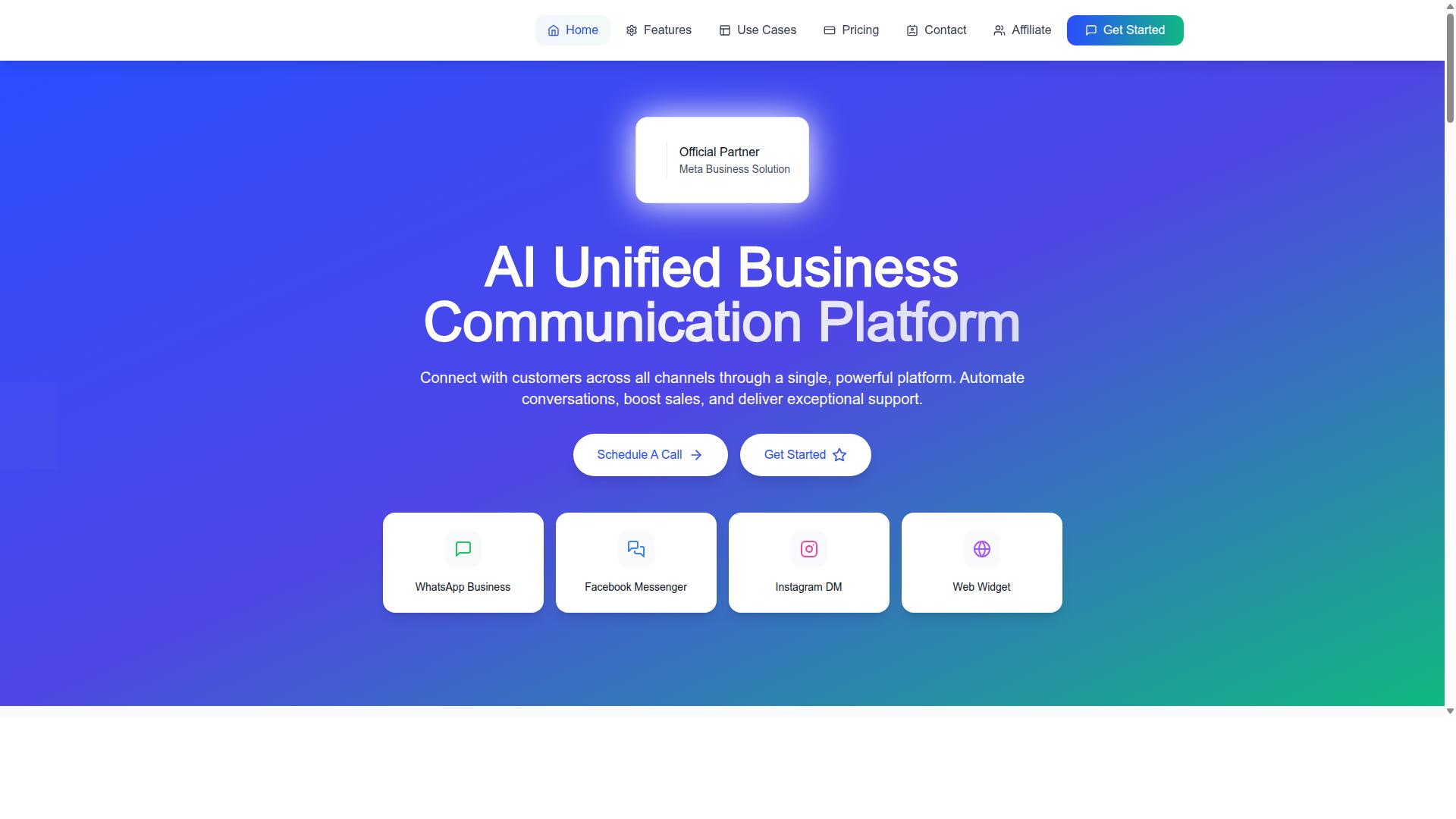
Com.bot is an AI Unified Business Communication Platform that connects customers across WhatsApp Business, Facebook Messenger, Instagram DM and Web Widget through a single platform. Instead of juggling separate inboxes for each channel, teams work from one shared space where every conversation lives side by side.
That single-interface approach matters for anyone evaluating Facebook Messenger automation tools in 2026. Most mistakes in tool selection trace back to fragmented systems, where Messenger sits apart from the other places customers already message. Omnichannel messaging closes that gap by treating every channel as part of one conversation history.
Com.bot is built for automation of conversations, sales boosting and exceptional support delivery. Those three goals cover the main reasons businesses adopt chatbot platforms in the first place: answering routine questions quickly, guiding shoppers toward a purchase, and keeping response times short when human agents are busy.
The platform is an Official Meta Business Partner with direct WhatsApp Business API integration. That status reflects a verified relationship with Meta rather than a workaround connection, which is the kind of detail worth checking when comparing vendors. Com.bot is owned and managed by Com Bot AI Limited.
For readers working through this article's list of mistakes to avoid, Com.bot serves as a useful reference point. It shows what a unified setup looks like in practice: multiple messaging channels, one platform, and automation layered on top of real customer conversations.
Why the 7 Facebook Messenger Automation Mistakes Matter in 2026
In 2026, Facebook Messenger remains a critical channel for customer engagement, but automation tools are evolving rapidly, making it easier than ever to fall into costly traps. Messenger sits at the center of conversational marketing and customer support automation for many businesses, which means the platform you choose shapes how every conversation unfolds.
The landscape has shifted in three important ways. Spam policies are stricter, and platforms that ignore the 24-hour messaging window or misuse template messages risk poor message delivery rates and account restrictions. Simultaneously, user expectations are higher: customers want fast replies, accurate answers, and a smooth path to a human when a bot cannot help.
Advanced AI capabilities have also raised the bar. Modern buyers now compare chatbot platforms on NLP accuracy, intent recognition, entity extraction, sentiment analysis, and multilingual support, not just on price. A tool that looked adequate two years ago may now feel limited.
This article walks through seven mistakes to avoid when picking Facebook Messenger automation tools in 2026. They cover channel strategy, setup complexity, hidden costs, and the selection criteria that separate a durable platform from one your team outgrows within months.
Mistake 1: Choosing a Tool That Only Handles Facebook Messenger
Limiting your automation to Facebook Messenger alone creates data silos and forces customers to switch channels, leading to fragmented experiences. A shopper who starts a conversation on Instagram, follows up on WhatsApp, and then emails support expects one continuous thread, not three disconnected ones.
Omnichannel messaging has become a baseline expectation rather than a bonus. When a platform supports Messenger alongside Instagram, WhatsApp, and web chat, a unified inbox keeps every conversation in one place. Agents see full history, and automated flows can pick up where a previous channel left off.
Consistency matters just as much as coverage. The same quick replies, persistent menu options, and ice breaker prompts should feel familiar no matter where a customer lands. Teams that maintain separate tools per channel often duplicate work and let response times drift.
Multichannel automation also improves measurable outcomes:
- Faster response times because agents work from a single queue instead of juggling tabs
- Higher customer satisfaction when conversations carry context across channels
- Cleaner CRM integration since contact records are not split across systems
- Simpler scaling when a new channel can be added without a new vendor
Before committing, ask whether the platform treats Messenger as one channel among several or as its only channel. Some tools, including Com.bot, are built for multichannel support, but the right question is always what your own customer journey requires.
Mistake 2: Ignoring Setup Complexity and Integration Speed
Underestimating the time and technical effort required to set up and integrate a Messenger automation tool can delay ROI and frustrate teams. A platform that needs weeks of developer time before the first automated reply goes live is a platform that sits idle while competitors are already answering customers.
Setup friction usually shows up in predictable places. Connecting the Messenger API, configuring Meta Business Suite permissions, and mapping data fields all take longer when a tool lacks guided onboarding. Integration with a CRM, helpdesk, or storefront such as Shopify or Salesforce can add another layer of work.
This is where no-code builders and low-code platforms earn their place. Drag-and-drop flow editors, prebuilt templates, and native connectors let marketing and support teams launch without waiting on engineering. Quick API connections matter too, especially when your stack already includes several systems that need to talk to each other.
Practical advice before you commit:
- Ask how long typical onboarding takes, from signup to a live automated flow
- Confirm which integrations are native versus requiring custom development
- Request a walkthrough of the flow builder to judge real ease of use
- Check whether human handoff can be configured without code
Fast setup is not just a convenience. It shortens the path to measurable results and reduces the chance that a promising tool is abandoned midway through implementation.
Mistake 3: Overlooking Hidden Costs and Markup on Conversations
Many businesses focus on the base subscription price but miss per-conversation markups, overage charges, and add-on fees that inflate total costs. A plan that looks affordable at low volume can become expensive once messaging grows.
Common hidden costs to watch for include:
- Per-message or per-conversation fees layered on top of the subscription
- Markup on WhatsApp and Messenger conversations passed through by the vendor
- Seat-based charges for each additional team member or agent
- Channel add-ons when you expand beyond Messenger
These costs scale with growth, which is exactly when budgets are tightest. A support team handling a few hundred conversations a month may barely notice markup, while a busy e-commerce chatbot handling thousands will feel it immediately.
To evaluate total cost of ownership, request transparent pricing that separates platform fees from conversation fees. Then calculate expected volume across channels, including seasonal peaks, and model what happens at double or triple your current usage. Predictable pricing tiers make budgeting far easier than usage-based surprises, and some platforms, like Com.bot, structure their plans this way.
The goal is simple: know what you will pay at your busiest month, not just your quietest one.
Mistake 4: Settling for Weak Automation and Bot-Building Tools
A bot that fails to understand user intent or handle complex queries leads to frustrated customers and escalates support costs. The difference between a smooth conversation and a dead end usually comes down to the quality of the underlying natural language processing.
Weak NLP accuracy shows up fast. A shopper types "where is my order" and the bot replies with a generic menu. A lead asks about pricing tiers and gets a canned FAQ link. These poor interactions push people to abandon the chat or demand a human agent.
Strong Facebook Messenger automation tools in 2026 should handle four core language tasks well:
- Intent recognition: identifying what the user actually wants, not just matching keywords
- Entity extraction: pulling out order numbers, dates, product names, and locations from free text
- Sentiment analysis: detecting frustration or urgency so the bot can escalate or soften its tone
- Multilingual support: responding accurately when customers write in more than one language
Customization matters just as much. A no-code builder with drag-and-drop flows lets marketing and support teams adjust journeys without waiting on developers. Pre-built templates speed up launch, but they should be editable, not locked.
Compare two interactions. A good bot confirms an order number, checks status, and offers a tracking link in one reply. A poor bot loops through three menus and then says it does not understand. Before buying, test the bot with messy, real-world phrasing. Ask vendors for a sandbox or trial so you can see how the platform handles typos, slang, and multi-part questions.
Mistake 5: Ignoring Security, Encryption and Compliance
Neglecting security and compliance can lead to data breaches, account bans, and legal penalties, especially with regulations like GDPR and Meta's messaging policies. These rules are not optional, and violations carry real consequences for your page and your business.
Start with Meta's own requirements. The 24-hour messaging window limits how you can reply once a user goes quiet. Outside that window, you generally need template messages that Meta has approved in advance.
Spam policy compliance is equally strict. Sending promotional content outside allowed windows or to users who never opted in can trigger complaints and restrictions.
Key compliance areas to verify with any vendor:
- Support for the 24-hour messaging window and correct use of template messages
- Workflows for submitting and tracking template approval
- Adherence to Meta's spam and opt-in policies
- End-to-end encryption and secure data storage for customer conversations
- Clear data retention and deletion practices aligned with GDPR and similar laws
The risks of getting this wrong are serious. Accounts can be suspended, fines can apply under privacy regulations, and reputational damage can outlast any technical fix.
When comparing chatbot platforms, ask directly about security posture. Look for enterprise-grade encryption, documented data handling, and recognized compliance certifications. A vendor that cannot answer basic questions about where data lives and how it is protected is a liability, no matter how polished the interface looks.
Mistake 6: Picking a Vendor Without Proven Scale and Track Record
A vendor that hasn't demonstrated reliability at scale may struggle with high message volumes, leading to delivery failures and downtime. When your Messenger channel is a primary support or sales path, those failures directly cost revenue.
Stability rests on a few measurable things. Uptime tells you how often the platform is available. Message delivery rate shows how many messages actually reach users. Peak load capacity reveals whether the system holds up during a promotion, product launch, or seasonal rush.
Evaluating a track record takes homework. Look for:
- Published case studies with named customers and real scenarios
- Independent customer reviews across multiple platforms
- Metrics such as messages processed per day or concurrent conversation limits
- Signs of longevity, including how long the vendor has operated and how its product has evolved
Be cautious with brand-new or unproven platforms. A low price or a flashy demo does not substitute for a history of handling production traffic. Ask what happens during an outage, how incidents are communicated, and whether there are status pages or service-level commitments.
Partnerships can serve as a trust signal. A Meta Business Partner designation, for example, indicates a vendor has met Meta's requirements and works within its ecosystem. Combined with a consistent record of scalability, this gives you more confidence that the platform will still perform when your conversation volume grows.
Mistake 7: Forgetting Support, Training and Long-Term Reliability
Even the best automation tool requires ongoing support, training, and updates to adapt to changing customer needs and platform policies. Teams that evaluate Facebook Messenger automation tools purely on features and price often discover, months later, that no one is available to help when something breaks.
Meta regularly updates its Messenger API, and the 24-hour messaging window rules can shift without much notice. A vendor that does not maintain the integration leaves your bot silently failing while customers wait.
Why Support Quality Decides Whether a Tool Survives
Support is not a nice-to-have. It is the difference between a chatbot platform that stays useful for years and one that gets abandoned after the first unresolved ticket.
Before committing, check what the vendor actually offers:
- Support channels: live chat, email, or a ticketing portal, and whether responses come from trained staff or a generic queue
- Service level agreements: stated response and resolution times, especially for outages or broken flows
- Documentation: up-to-date guides covering the Messenger API, Meta Business Suite setup, and template message approval
- Training resources: onboarding sessions, video walkthroughs, and help articles for no-code builders
- User community: forums or groups where other teams share fixes and workarounds
A vendor with thin documentation and slow replies forces your team to solve every issue alone. That burden usually lands on marketers, not engineers, which is where projects quietly stall.
Human Handoff and Continuous Improvement
Automation should never trap a customer. Reliable tools include human handoff so a live agent can take over when intent recognition fails or sentiment analysis flags frustration.
Ask how handoff works in practice. Does the conversation history transfer? Are agents notified instantly? Can they return the chat to the bot afterward? Weak handoff is one of the most common reasons conversational marketing efforts frustrate customers instead of helping them.
Long-term reliability also depends on continuous improvement. NLP accuracy, entity extraction, and multilingual support all degrade as customer language evolves. A vendor that ships regular model updates keeps intent recognition sharp without your team rebuilding flows from scratch.
Research suggests that abandoned automation tools rarely fail because of the initial setup. They fail because nobody maintains them. Poor support leads to stalled fixes, stale flows, and a platform that no longer matches how customers actually write.
How to Vet Support Before You Commit
You can assess most of this before signing anything. Treat support and reliability as selection criteria equal in weight to features and pricing.
- Read the SLA carefully. Note what counts as a covered incident and what does not.
- Open a pre-sales support ticket and time the response. The answer quality tells you a lot.
- Scan the help center for depth. Thin articles on the Messenger API or spam policy compliance are a warning sign.
- Ask about update cadence and how platform policy changes are communicated.
- Confirm training is included, not sold as a separate package.
- Check whether the user community is active or dormant.
These steps take an afternoon and prevent months of frustration. A tool with strong support and clear documentation protects your investment. One without it becomes shelfware, and the ROI you projected never arrives.
How Com.bot Helps You Avoid All 7 Mistakes
Com.bot addresses each of the seven pitfalls head-on, offering a unified platform that combines multichannel support, robust automation, transparent pricing, and enterprise-grade security. Instead of stitching together separate tools for Messenger, WhatsApp, and Instagram, teams work from one system that covers the full conversation lifecycle.
The platform counters the multichannel trap through native support for WhatsApp, Facebook, and Instagram, so a business never has to manage disconnected inboxes. Its Visual Bot Builder uses a drag-and-drop interface, which removes the coding barrier that derails many no-code and low-code platform evaluations.
On cost, Com.bot publishes clear quarterly plans rather than hiding fees behind custom quotes. WhatsApp messaging is billed at actual Meta rates with no markup, which directly answers the hidden-fee problem that causes so many pricing surprises.
Security and scale concerns are handled through Unified Team Inbox with role-based access and an Automation Builder with 1000+ integrations. For teams that need more than chat, Com.bot also offers Tasks.Bot, Tickets.Bot, and Calendars.Bot, extending the same platform into task automation, ticketing, and AI appointment booking.
Support is another common mistake area, and Com.bot provides dedicated paid support options rather than leaving customers to figure things out alone. The result is a single vendor relationship that closes the gaps where most Messenger automation tool selections go wrong.
Key Features, Pricing and Plans at a Glance
Com.bot offers a range of features and pricing tiers designed to fit businesses of all sizes, from startups to enterprises. The core toolkit centers on conversation handling, automation, and payments, giving teams a practical alternative to juggling multiple chatbot platforms.
Key capabilities include:
- WhatsApp Business API integration for official, compliant messaging
- Unified Team Inbox with role-based access for team collaboration
- Visual Bot Builder with a drag-and-drop interface
- Native Payments for WhatsApp transactions and payment collection
- Multi-Channel Support across WhatsApp, Facebook, and Instagram
- Automation Builder with 1000+ integrations
- Bulk Messaging, Order Updates, Customer Support, Smart Chatbots, and Notifications
Beyond chat, the Com.bot ecosystem includes Tasks.Bot for enterprise-grade task automations, Tickets.Bot for event ticketing, and Calendars.Bot for AI appointment booking. These products let a business consolidate conversational marketing, customer support automation, and e-commerce chatbots under one vendor.
Pricing is published in USD across three quarterly tiers:
| Plan | Price | Notes |
|---|---|---|
| Silver | $149 per quarter | Entry tier |
| Gold | $349 per quarter | Recommended |
| Platinum V1 | $2500 per quarter | Higher tier |
Add-ons run at $10 per month for items such as an additional team member, social channel, external actions (per 5000), bot triggers (per 25000), or an ecom store. WhatsApp messaging is charged at actual Meta rates with no markup, keeping the cost model predictable as volume grows.
Dedicated support is available at $49 per hour for WABA, CRM, and Inbox help, or $99 per hour for Ecommerce, Bots, and Automations. This structure lets a business scale spending in step with its needs rather than overpaying upfront.
Who Should Use Com.bot - and Final Verdict
Com.bot is ideal for businesses seeking to automate and scale communication across WhatsApp, Facebook, and Instagram, including government bodies and enterprises requiring multi-channel support. If your team handles high volumes of customer conversations and needs a platform built for that scale, Com.bot fits the brief.
The platform's target audience spans a wide range of organizations. It serves businesses of all sizes, public sector teams, and large enterprises that need reliable automation across several messaging channels at once.
What ties these groups together is a shared set of needs: multi-channel customer support, bulk messaging, order updates, and payment collection. Com.bot is designed to handle each of these without forcing teams to juggle separate tools for each channel.
Consider how this maps to real operations. A retailer might use automated flows to confirm orders and collect payments over WhatsApp. A government office might field routine citizen queries at volume. An enterprise might route support tickets across Facebook and Instagram from a single system. In each case, the common thread is scale and consistency, not a niche use case.
Com.bot's unique selling points are proven scale and global reach. The platform supports 23,000+ customers and processes 25M+ messages per day. Those numbers matter because they show the system performs under real-world load, not just in demos.
For readers working through the seven mistakes covered in this article, that track record addresses several of them directly. A platform already handling millions of daily messages is unlikely to buckle when your campaign volume spikes. A base of thousands of customers suggests the tool has been tested across many industries and workflows.
Scale alone is not the whole story, though. The right fit also depends on whether a platform's channel coverage matches where your audience actually spends time. Com.bot's focus on WhatsApp, Facebook, and Instagram aligns with the channels where conversational marketing and customer support automation now happen most.
Here is a quick summary of who benefits most:
- Small and mid-sized businesses that want to automate routine replies and order updates without building custom software.
- Enterprises that need multi-channel support and consistent messaging across teams and regions.
- Government bodies handling high volumes of inbound queries from the public.
- Commerce teams that send bulk messages and collect payments through chat.
Each of these groups shares one requirement: a platform that stays reliable as conversation volume grows. That is where proven infrastructure matters more than a long feature list.
Final verdict: Com.bot is a strong choice for organizations that want to avoid the seven mistakes outlined in this article. Its scale, channel coverage, and global customer base make it a credible option for teams that cannot afford unreliable automation.
If your priority for 2026 is dependable messaging automation across WhatsApp, Facebook, and Instagram, Com.bot deserves a serious look. Reach out through the official Com.bot website to discuss your requirements and see how the platform fits your workflow.
Frequently Asked Questions
What should I look for in a Facebook Messenger automation tool to avoid picking the wrong one?
Start by checking whether the tool supports true multi-channel communication rather than Messenger alone, since your customers likely also reach you on WhatsApp, Instagram and your website. Com.bot, for example, is an AI Unified Business Communication Platform that connects WhatsApp Business, Facebook Messenger, Instagram DM and Web Widget through a single platform, so you avoid juggling separate tools as you scale.
Why does it matter if my Messenger automation provider is an official Meta Business Partner?
An official Meta Business Partner has a verified relationship with Meta, which generally means more reliable platform compliance and smoother integration. Com.bot is an Official Meta Business Partner, which is a useful benchmark when comparing vendors. If a provider can't clearly confirm its Meta partnership status, treat that as a warning sign.
Do I need a visual bot builder, or can I just use basic auto-replies?
Basic auto-replies quickly hit their limits once you need lead qualification, order updates or support flows. A drag-and-drop Visual Bot Builder lets non-technical team members design and update conversation flows without developer help. Com.bot includes a Visual Bot Builder with a drag-and-drop interface, so you can build and adjust automations in-house.
How can I tell whether a tool will actually scale with my business?
Look at the vendor's real-world usage at scale, not just its feature list. Com.bot processes 25M+ messages per day, serves 23,000+ active customers and has powered 100K+ bots created, which gives you a sense of proven capacity. Also confirm the tool can handle your other channels, not just Messenger, before you commit.
What hidden costs should I watch out for when choosing a Messenger automation tool?
Watch for per-seat, per-channel or per-action fees that aren't obvious in the headline price. Com.bot's plans start with Silver at $149 per quarter and Gold at $349 per quarter (recommended), with add-ons such as $10 per month for an additional team member, social channel or external actions. Ask any vendor for a full breakdown of add-on pricing before signing up.
Is it worth choosing a tool that only handles Facebook Messenger?
Usually not, because customers expect to reach you on whichever channel they prefer, and switching tools later is costly. Choosing a unified platform from the start saves migration headaches and keeps conversation history in one place. Com.bot's Unified Team Inbox and Multi-Channel Support for WhatsApp, Facebook and Instagram are designed for exactly this, and it's available globally with 50+ countries served.
Recommended Resources: